
Two-Step Holiday Inventory Management Guide for eCommerce

The holiday season is still the biggest revenue opportunity of the year for most eCommerce businesses, but it no longer looks the way it did a few years ago. Shoppers commit their budgets earlier, the peak has spread into a run of events stretching from November through to January, and that changes when your stock needs to land and how much of it you should hold back.
That makes a two-step approach to holiday inventory management more useful than ever. First, we'll cover the preparation phase: reading the peak season calendar, using last year's numbers properly, and setting stock goals you can actually fund. Then we'll move into the management phase, with the practices that keep you steady once orders arrive faster than you can pack them. Think of this as your playbook for growing your online business through the busiest weeks of the year, without the stockouts, the panic buys, or the shelves still full in February.
The Imperative of Holiday Inventory Management in eCommerce
For most online stores, the last quarter decides how the whole year finishes. Holiday inventory management isn't just a nice habit; it's the difference between a record quarter and an expensive lesson. The right products, in the right quantities, at the right time, is the whole game.
What has changed is the margin for error. The peak used to be a long December build. Now a huge share of the season's revenue moves in a handful of days in late November, so a bad decision in September shows up as an empty shelf on the busiest weekend of the year, with no time left to fix it.
Navigating the Risks of Inadequate Inventory Management
Picture your best seller running out on the Friday morning of the biggest sale weekend of the year. The lost sales are only the start. A shopper who can't buy from you has plenty of alternatives a tap away, and once they've bought from a competitor, you may have handed over a customer for good, not just an order.
Overstocking causes quieter damage. Excess stock ties up cash you need elsewhere, adds storage costs, and usually ends in discounts that eat the margin you worked all year to protect. Both problems come from the same root: buying on a hunch rather than a plan.
The Agility Factor in eCommerce Inventory Management
Peak season demand is unpredictable in ways it wasn't before. A creator mentions your product, a competitor sells out and their traffic lands on you, or a listing starts showing up somewhere you never targeted. Any of these can turn a steady seller into a stockout inside a day, which is why enough flexibility in your stock plan beats a perfect forecast.
Step 1: Preparing for Holiday Season with eCommerce Inventory Planning
Everything that goes well in November and December was decided months earlier. This step covers understanding when your customers actually buy, reading your own numbers properly, and setting stock goals that match your cash and your supplier reality.
Decoding Peak Season Trends and Consumer Behaviour
Start with the calendar, because the Australian peak has a shape of its own. Click Frenzy opens the run in mid-November. Black Friday and Cyber Monday follow at the end of the month and now form the single biggest shopping event of the year here. Christmas delivery cut-offs land in mid-December, Boxing Day kicks off the clearance period, and January brings the returns.
The size of that November weekend is the part worth planning around. Black Friday and Cyber Monday have been setting spending records here year after year, and they have overtaken Boxing Day as the moment the season is decided. Boxing Day still performs, but its growth has softened, because plenty of shoppers have already committed their budget a month earlier.
The practical takeaway is simple. If your stock plan assumes a December peak, your stock arrives late. Work backwards from the third week of November instead, and treat December as the follow-on rather than the main event.
Then narrow it to your own customers. Generic trend lists are a poor substitute for your own data, your customer emails, and a quick survey of your buyers about what they're planning to purchase and when.
Leveraging Past Holiday Sales Data for Inventory Planning
Your last peak season is the best forecasting tool you own, as long as you look at it closely enough. Pull daily sales, not monthly totals. Peaks are won and lost in days, and a monthly figure hides the shape entirely.
Look for three things. First, how much of the season's revenue landed in the Black Friday window compared with December, and whether that share has been growing year on year. If it has, expect it to keep going. Second, which products sold at full price and which only moved once you discounted them, because the second group is where you should buy less. Third, how quickly your top sellers ran down, which tells you the reorder point you actually needed rather than the one you guessed.
If you're building these numbers into a wider plan for the year, our guide to budgeting and forecasting covers how demand planning feeds the rest of your financials.
Setting Achievable Inventory Goals: Balancing Supply and Demand
Now turn the forecast into quantities you can fund and receive in time. Three constraints decide this: supplier lead times, storage space, and cash.
Lead times drive the calendar. If a key supplier needs six weeks, an order placed in October is a November delivery at best, and that's before shipping delays. Map every important product back from the date you need it on the shelf, then place the order earlier than feels necessary.
Cash decides the size. Every unit sitting in storage is cash you can't spend on advertising or a second product line, which is why stock levels and cash flow management have to be planned together rather than separately.
Two habits make this far more forgiving.
Split the buy. Commit to a first tranche, then hold a reserve of cash for a top-up once you can see what's actually selling.
Plan for returns as part of the goal. A sizeable share of online orders comes back, and items bought during big discount events are returned more often than everyday purchases. Some of that stock is sellable again and some isn't, so don't count all of it as inventory you'll recover.
Step 2: Managing the Holiday Rush with Active eCommerce Inventory
With the planning done, the season becomes a matter of watching the right numbers and acting quickly. These are the practices that keep the operation steady while volume climbs.
Real-Time Inventory Tracking: A Must-Have for eCommerce
Knowing your true stock position at any moment is the foundation everything else sits on. Good tracking tells you the moment a popular item drops below its reorder point, while there's still time to do something about it.
Accuracy matters more than it used to, because your stock and price information no longer feeds only your own website. It flows out to marketplaces, social shops, and increasingly to the AI assistants shoppers now use to compare products. If those numbers are wrong or slow to update, you either sell things you don't have or quietly disappear from places you could have been found. This is the main reason peak season is hard to run on spreadsheets, and where inventory software that updates in real time earns its keep.
Maximising Warehouse Efficiency During Peak Season
More stock in the same space needs a better layout. Vertical storage lets you hold more without renting more floor. Beyond that, move your expected best sellers closest to the packing bench, pre-pack the most common order combinations, and optimise your picking route so nobody is walking the length of the room for a single item.
If a third party handles your fulfilment, the equivalent work is knowing their peak calendar. Ask for their cut-off dates, their peak surcharges, and their receiving deadlines well before November, because a shipment that arrives after their intake closes may as well not exist. Our comparison of fulfilment methods is a useful reference if you're weighing a change before the season starts.
Supplier Collaboration: Your Secret Weapon for Holiday Success
Your suppliers can save your season, but only if they know what's coming. Share your forecast early, tell them which products you're most likely to reorder, and agree what a rush order looks like before you need one. Favourable terms negotiated in September are worth far more than a desperate phone call in November.
Ask about their shutdown dates too. Many suppliers close over Christmas, and factories across Asia stop for Lunar New Year, so a gap in supply through January and February catches out plenty of Australian retailers who only planned as far as Boxing Day.
Streamlining Returns and Exchanges Without Losing Margin
Returns arrive in a wave after the peak, and January is the heaviest month for them. Treating this as an afterthought is expensive, because processing a return can consume a large share of an item's value once you add up return postage, checking, repacking, and the discount you eventually take to sell it again.
Make the process easy for the customer and fast for you. Decide in advance which products are worth restocking and which aren't, get sellable items back into your available stock quickly so they can be sold again while demand is still there, and make sure returned stock shows up in your system rather than sitting in a box behind the desk.
The cheapest return is the one that never happens. Clear sizing information, honest photography, and accurate delivery dates prevent more returns than any policy change.
Dynamic Pricing: Balancing Revenue and Inventory Levels
Pricing is a lever for managing stock, not just revenue. If something is moving faster than expected, you can ease off the discount rather than keep promoting it. If something is barely moving by early December, discount it while shoppers are still buying, instead of holding out and clearing it in February for less.
Two cautions. Work out what a discount does to your profit before you run it, because a promotion that clears stock but loses money hasn't helped; our guide to discounts and promotions walks through that calculation. And be careful with comparison pricing. If you advertise a "was" price, it needs to be a price you genuinely sold at recently. Lifting a price shortly before a sale so the discount looks bigger is exactly the kind of claim that draws customer complaints and regulator attention, so keep a record of your pricing through the season.
Leveraging Data Analytics for Agile Inventory Management
During peak, a weekly report is too slow. Watch a short daily list instead: units sold per product, how many days of stock you have left at the current rate, and anything getting plenty of views but few sales.
That last one is worth acting on quickly. A product with strong traffic and weak conversion usually has a fixable problem, whether that's price, delivery timing, or an unclear listing.
Keep an eye on where your orders are coming from as well. More shoppers now start with an AI assistant rather than a search box, and that traffic has been climbing quickly through recent peak seasons, often converting better than average because the buyer has already narrowed the field. We cover the shift in more detail in our playbook for AI-powered shopping. For inventory, the point is practical: demand can arrive through a channel you didn't plan for, so be ready to move stock and attention behind whatever starts working.
Customer Communication: Building Trust Through Transparency
Shoppers forgive a lot when they know what's happening. Publish your last-order dates for Christmas delivery prominently and hold to them, because overpromising is the fastest way to turn a sale into a refund and a poor review.
When something sells out, say so clearly and give people a reason to stay: an expected restock date, a pre-order option, or a genuine alternative. That keeps the customer in your world rather than sending them off to search elsewhere.
Emergency Contingency Plans: Preparing for the Unexpected
Even a good plan meets surprises, so decide your responses before you need them. Have a secondary supplier identified for your most important products, keep a buffer of stock on your best sellers, and know which courier you'd switch to if your usual one falls behind.
Plan for the good surprise too. If something sells out in a day, what happens next? Deciding in advance whether you take back-orders, offer a substitute, or move your advertising spend to a product you can actually ship will save you a day of indecision at the worst possible moment.
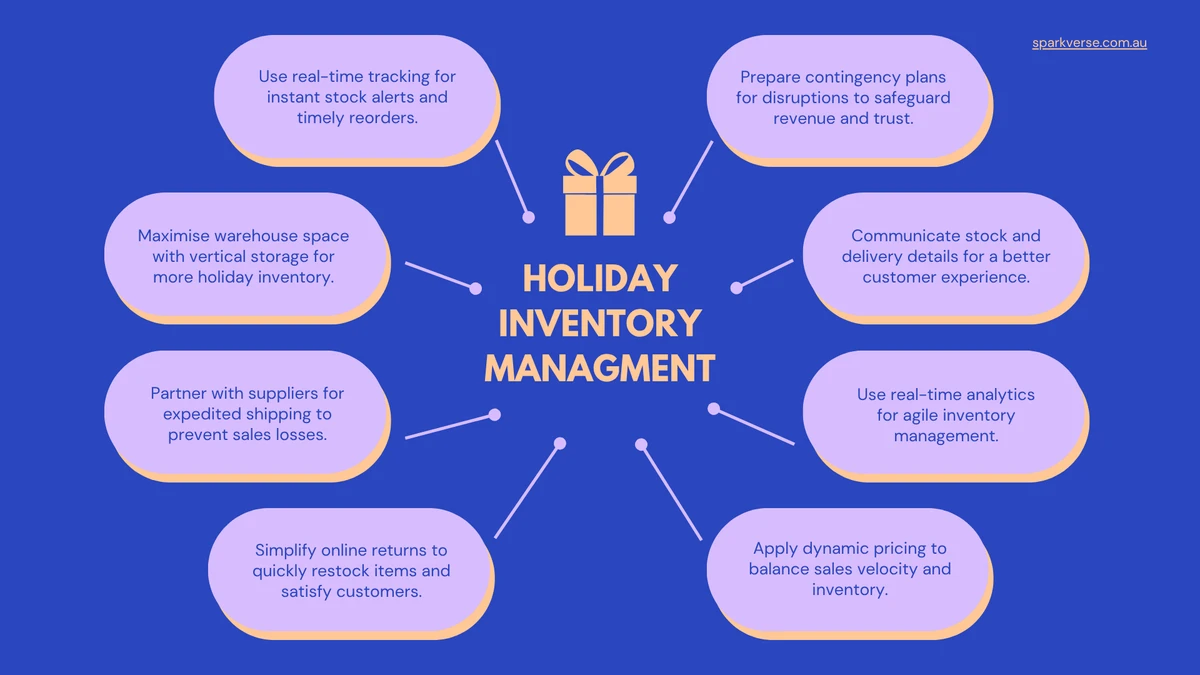
The Tools That Make Peak Season Manageable
You don't need a large software stack to run a good peak season. You need two things: an accurate, real-time view of what's actually on the shelf across every channel you sell on, and a forecast you trust enough to buy against. Modern platforms now handle both, predicting demand product by product and drafting the reorder before you run short, which is what turns the planning in Step 1 into something you can act on in Step 2.
Which one suits you depends on how you sell, how much you make yourself, and how many channels you manage. We've compared the leading options, with current pricing, in our guide to inventory management software for eCommerce.
Conclusion: Your Roadmap to Holiday Inventory Management Success
Holiday inventory management looks daunting from the outside, but it comes down to two disciplines done in order: prepare properly, then manage actively. Work backwards from a November peak rather than a December one, set stock goals your cash and your suppliers can actually support, and once the season starts, watch a small set of numbers every day so you can act while there's still time.
The stores that finish the year strongly aren't the ones that guessed the trends correctly. They're the ones that planned early and stayed flexible. Get those habits in place and peak season stops being the most stressful part of your year and becomes the part that funds your growth.
If you'd like a hand building the plan, or working out how to scale your operations before the next peak, that's exactly the kind of work we do with eCommerce owners. Get in touch, and let's make this season your best one yet.